
Apple Ads — the platform formerly branded Apple Search Ads — has nothing to do with who owns Apple the company. The two get tangled together in search results because both live under the word "Apple" and "ads," but one is a self-serve advertising product for app developers and the other is a question about corporate ownership and a founder's legacy. This article covers both, starting with how the ad platform actually works end to end, then answering the ownership question directly.
Advertiser creates a campaign in Apple Ads
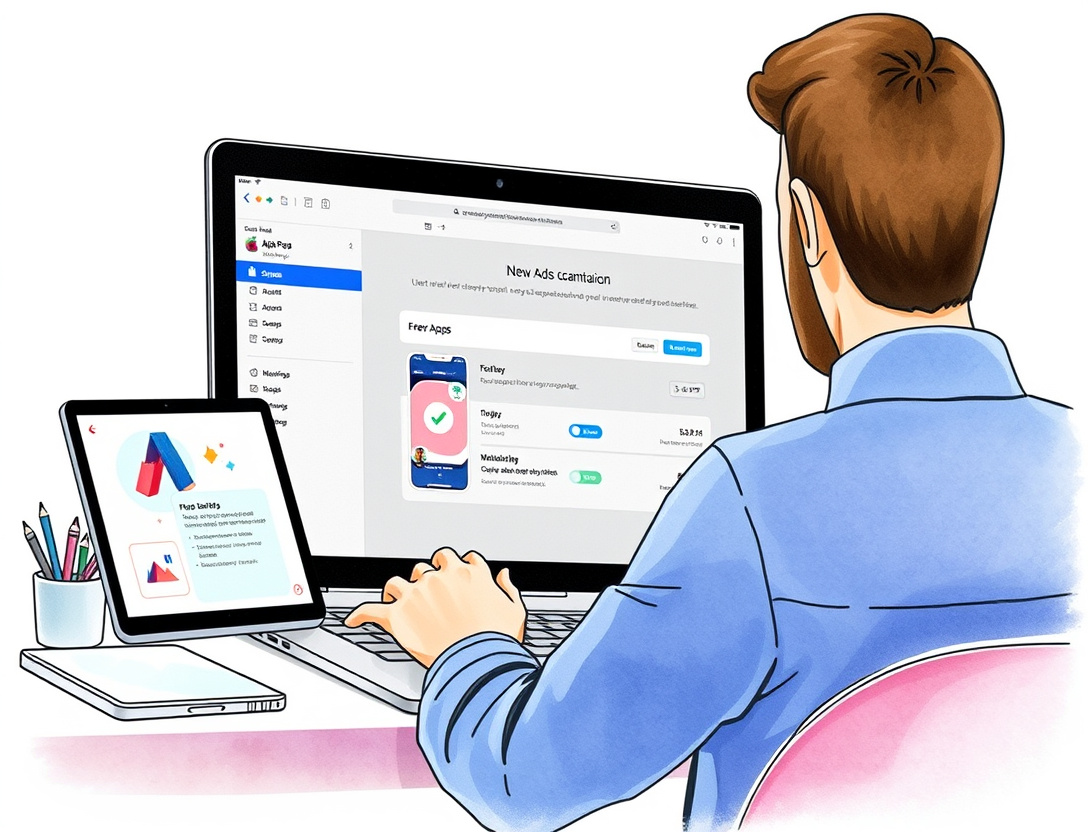
An advertiser — typically an app developer or a marketer working on their behalf — opens an Apple Ads account and builds a campaign around a single app they want people to discover in the App Store. The campaign is the structural container: it holds a budget, a set of keywords or audience conditions, and the creative that will actually appear on screen.
Once a campaign is live, it doesn't run in isolation. Every time a user opens the App Store and searches or browses in a way that matches the campaign's targeting, that campaign enters an auction against every other advertiser trying to reach the same moment. The auction is resolved through bidding, and the winning bid, combined with the type of placement being contested, determines what the advertiser actually pays. The end result — assuming the ad wins its slot and a user acts on it — is an app download, the single outcome the whole system is built to produce.
That's the full loop in miniature: set up a campaign, compete in an auction, pay based on the outcome, generate a download. Everything else on the buy side is refinement of these four steps.
Apple collects account, device and download data
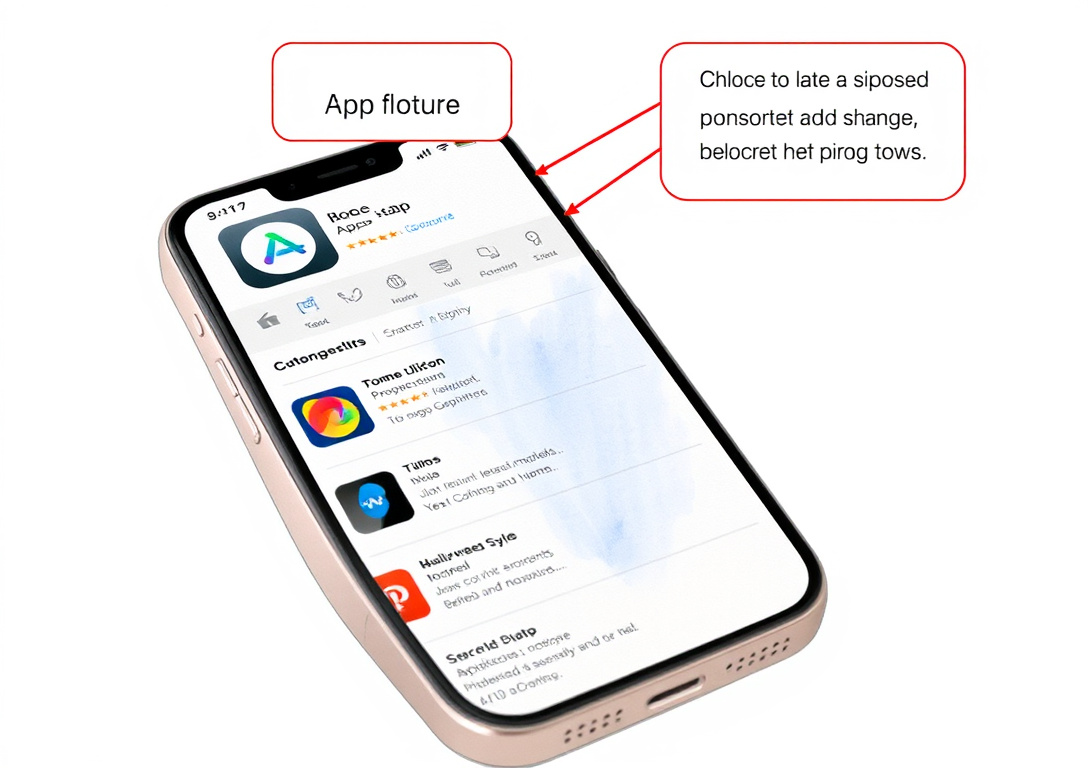
Running ads at all depends on Apple having data to target with, and that data comes from three places: the user's Apple Account, the device itself, and a history of what that device has downloaded. This is the same data that lets Apple show personalized ads not just in the App Store but across other Apple surfaces, including Apple News and the Stocks app.
A user who doesn't want ads built on that profile can turn the setting off directly on the device, in Settings under Privacy & Security, then Apple Advertising. Turning this off does one specific thing: it stops ads from being personalized to that account's data. It does not reduce how many ads appear, and it does not remove ads from the App Store, News, or Stocks — the ad slots are still filled, just without the targeting layer that was built from the user's own activity. That distinction matters because the two effects — fewer ads versus less-tailored ads — get conflated in casual explanations of the setting, and only one of them is true.
Advertiser needs to know which placements paid off
Once a campaign has been running for a while, the advertiser's next problem is figuring out which of the auctions it won were actually worth winning. Apple Ads reports downloads back to the advertiser through attribution and post-install measurement — the mechanism that connects a specific ad impression or tap to a download that happened afterward, so spend can be tied to a result rather than judged on impressions alone.
With that reporting in hand, the advertiser can see which placements, keywords, or audience segments produced downloads at an acceptable cost and which didn't. The standard response is to adjust bids downward or pause targeting on placements that are burning budget without converting, and to shift spend toward the combinations that are converting well. This adjustment loop — measure, then rebid — is what turns a single campaign into something that improves over time instead of running the same settings indefinitely.
App Store
The App Store is the primary surface where Apple Ads actually appear. A user opening the App Store to search for a specific app, or simply to browse a category, is shown ads alongside organic results, and those ads are visually similar enough to organic listings that Apple labels them to distinguish sponsored placements from unpaid ones. Nearly all Apple Ads activity — the campaigns, the auctions, the resulting downloads — happens inside this one app, which is why placement type within the App Store matters more to an advertiser than which broader Apple surface the ad theoretically could appear on.
Ad placement
Ad placement is the specific slot an ad occupies once it wins an auction, and not all slots behave the same way. The three placements advertisers work with most are:
- Search results — ads that appear alongside or above organic search results when a user types a query, competing directly with keyword-matched intent.
- Today tab — ads shown in the App Store's editorial browsing tab, reaching users who aren't actively searching for anything specific.
- Product pages — ads shown on the page for a related or competing app, reaching users already evaluating a similar download.
Search results placements tend to attract the most competitive bidding because they capture a user already looking for something close to what the advertiser offers, while Today tab and product page placements reach users earlier or later in that decision, which changes both the bidding dynamics and the resulting cost.
Bidding
Bidding is the auction mechanism that decides which advertiser's ad actually gets shown when more than one campaign is eligible for the same placement at the same moment. Advertisers set a maximum amount they're willing to pay, and the auction resolves in real time based on that bid combined with other signals Apple factors into the ranking of eligible ads.
Because bidding is an auction rather than a fixed rate card, there's no single price for a placement — the same keyword or slot can cost noticeably different amounts depending on how many other advertisers are competing for it at that moment and how relevant each one's ad is judged to be. That's the reason two advertisers targeting an identical keyword can end up with very different average costs per result.
Campaign cost
| Placement type | Typical competition | Main cost driver |
|---|---|---|
| Search results | High — matches active search intent | Keyword popularity and bid density |
| Today tab | Moderate — editorial browsing traffic | Broader targeting, less intent-specific |
| Product pages | Variable — depends on the target app's traffic | Relevance to a specific competing or complementary app |
Campaign cost is the output of everything above: the bid an advertiser sets, the placement it's competing for, and how much competition exists for that placement at that moment. A campaign built around a highly searched keyword in search results will generally cost more per result than one aimed at a quieter product page, simply because more advertisers are chasing the same search-result slot. This is why advertisers comparing performance across placements need to look at cost per download rather than raw spend — a more expensive placement can still be efficient if its downloads are cheaper once conversion is accounted for.
App download
The app download is the conversion event the entire system is optimized toward — not the ad impression, not the tap, but the completed install that follows. Every earlier step in the funnel — campaign setup, the auction, the placement won, the bid paid — exists to produce this one outcome, and it's the event that attribution and post-install measurement report back to the advertiser so cost and result can be compared directly. An advertiser evaluating whether Apple Ads is working ultimately reduces the whole system to one ratio: how much was spent, against how many downloads it produced.
Does Steve Jobs still own Apple?
No. Steve Jobs did not own Apple by the time he died, and no individual owns Apple today — it has been a publicly traded company for decades, with shares held by institutional and individual investors rather than controlled by any single founder. Jobs's own stake in Apple had been diluted over the years since the company's founding, and his primary personal fortune later in life came from his ownership of Pixar rather than from a controlling position in Apple, according to his Wikipedia biography.
Was Steve Jobs the CEO of Apple when he died?
No — he resigned as CEO in August 2011 for health reasons and died two months later, in October 2011, with Tim Cook already installed as his successor, as documented in the same biography.
Why did Steve Jobs quit Apple?
Jobs didn't originally leave by choice. In 1985, Apple's board sided with then-CEO John Sculley in a power struggle and effectively pushed Jobs out of any operational role, a decision examined in detail by the Corporate Governance Institute's case study on the episode. He went on to found NeXT and to lead Pixar before Apple's acquisition of NeXT brought him back into the company in the late 1990s, a return traced in Entrepreneur's career retrospective.
Why did Steve Jobs keep the name Apple?
Apple was co-founded by Jobs and Steve Wozniak, along with Ronald Wayne, in the mid-1970s, and the company kept the name through every subsequent reinvention of its product line — from early personal computers to the iPhone — rather than rebranding around any single later product, a continuity outlined in the Lemelson-MIT profile of Jobs and Wozniak's early partnership. The name predates the products people associate with it today, which is part of why it never changed even as the company's business shifted from computers to phones to services.
Jobs's death ended his operational role at Apple, but not his association with it: institutions from the National Inventors Hall of Fame to the National Medals continue to credit him for the products built under his leadership, even though none of that recognition amounts to ownership of the company he co-founded.